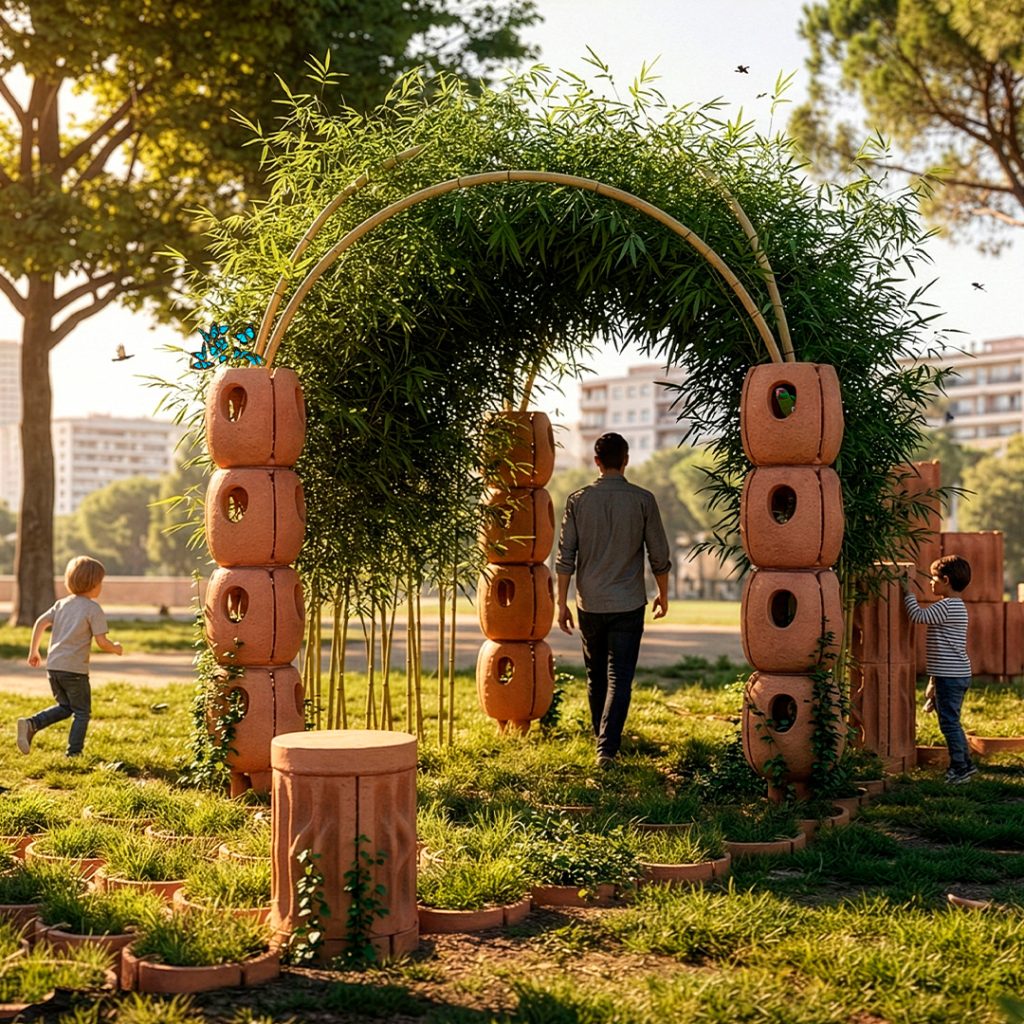
Co-inhabited Landing

The project aims to offer an integrated perspective on the nature of the problem and on possible interventions. It does not seek to compete with similar design approaches, but rather rejects a competitive framework.
0
Bioeconomy
0
Ecodesign
0
Low-impact Textiles
0
Artificial Intelligence
Digital Product Passport
0
Traceability
0
Circular Business Models
0
Life-Cycle Thinking
Global temperature increases are making cities increasingly uninhabitable. soil sealing, the lack of green spaces and ecological fragmentation intensify the urban heat island effect, directly affecting quality of life and environmental balance. In this context, it is necessary to rethink urban design beyond a solely human-centred perspective, adopting a biocentric approach. The biocentric perspective developed through ISIA Faenza’s research recognises the value of all forms of life and their interdependent relationships. Applied to urban design, it encourages us to consider plants, animals and microorganisms as co-inhabitants, and to design spaces that support biodiversity, environmental well-being and climate adaptation. Co-inhabited Landing develops design devices and strategies for the climate-oriented regeneration of urban spaces. Its objectives are to reduce temperatures, support co-habitation strategies among different species, and improve mobility and quality of life in a sustainable way.
In 1818, temperatures in the densely populated areas of newly industrialised London were recorded as being 1.3°C–3°C higher than in the surrounding rural areas. Meteorologist Luke Howard recognised the anthropogenic origins of the phenomenon, which was primarily linked to domestic coal use and poor street ventilation. Decades of urban expansion based on asphalt, concrete and steel, combined with the rapid drainage of rainwater, mass mobility and, paradoxically, air-conditioning systems themselves, have transformed urban heat islands into genuinely hazardous environments. These phenomena are particularly intense in European cities, where historic street layouts and densely built areas further amplify solar heat accumulation during the summer months. Cities such as Paris, Milan and Madrid can be, on average, 10°C–15°C warmer than their surrounding peripheral areas. Considering that only approximately 20% of the European population lives in rural areas, together with the progressive increase in global temperatures, the scale of this phenomenon is both widespread and critical. Heatwaves negatively affect the human body, causing fatigue, sleep disturbances, migraines and other symptoms. During the summer of 2022, overheating in urban areas across Europe resulted in approximately 62,000 deaths, with a particularly significant impact on women and socially vulnerable groups, including older people, infants, individuals with chronic illnesses and outdoor workers. The overheating of urban centres can essentially be addressed only through a radical reconfiguration of the physical urban fabric – including materials, volumes, green spaces, road systems and water infrastructure. This will be a slow and complex process. In the meantime, citizens can only find ways to mitigate its effects and develop strategies for co-habitation strategies. Fundamentally invisible and elusive, urban heat islands have now become an integral part of our anthropogenic geography.


Co-inhabited Landing is currently at the prototype stage. The project received an honourable mention at ARWE – Art Research World Expo 2026

The design choice has not yet been supported by quantitative measurements; these are planned for subsequent stages of the project.

TEAM 
Federico Giustozzi, Giorgio Gurioli, Matteo Pini, Sabrina Sguanci, Ivan Severi, Carlo Turri.

STUDENTS Annalisa De Stanchina, Andrea Montanari, Irene Strada, Pietro Tabanelli; Angelo Verna, Panna Ori, Clara Ghirlanda. Jasmine Sahbaoui, Vera Vespignani, René Ricci; Simona Alessandrini, Giulia Calonici, Vito Cappiello, Chiara Casamenti, Martina Di Girolamo, Eleonora Dotti, Melissa Geti, Zeineb Kassimi, Michele Loiudice, Rosalba Maggio, Stefano Magnani, Francesca Sortino, Francesca Stefanelli, Federica Urbano.